Showing posts with label Review. Show all posts
Showing posts with label Review. Show all posts

The Raqqa Diaries - Samer* Published by Cornerstone
- I was kindly sent a copy by the publishers -
I think it's fair to say that I'm not alone when I say I know little to nothing about Syria. I know it's bad, I know people are dying and I know ISIS is involved. That's about the extent of it. And because like me, most people don't really know what's happening it's very hard to actually form an opinion more nuanced than 'this is shit and we should help', or in some cases 'this is shit, and not our problem.'
The Raqqa Diaries is the testimony of Samer, not his real name, a 24 year old man living in the city of Raqqa, territory that is completely occupied and controlled by ISIS. We watch as he attempts to make a life for himself in a city where the economy has been destroyed by heavy and seemingly arbitrary taxes, people are publicly beaten and executed for crimes such as 'wearing trousers that are too long', and all contact with the outside world is cut off under threat of death. From all that, Samer and his fellow activists have managed to smuggle out his account of life under the rule of ISIS.
If the idea of struggling through a dry and heavy piece of non-fiction is daunting, please don't be put off. The Raqqa Diaries is actually incredibly engaging and accessible. The narrative is broken up into short fragments describing a few scenes from his life, and it is presented with these sparse but powerful illustrations that really add texture to his words.
It is such a critical piece of media, because it adds a sense of humanity to the glimpses of war torn streets that we see on the news. It is so easy to allow ourselves to see something so alien and so far away, and forget that the people involved are human beings. Judith Butler (social humanities scholar and general hot bitch in charge) wrote a book called Frames of War in which she argues against the way in which we show war and strife in the media, how we encourage this dehumanising and othering of the people involved. The Raqqa diaries rails against this overarching scope of complex blame-gaming and political tip-toeing and shows, through the eyes of a single person, the horrors that make up the day to day lives of the people living through it all.
It's also incredibly important to understand this when we talk about 'dealing with Syria', I genuinely once had a conversation with a man on twitter who said that bombing Syria was a no brainer, because there was nobody left down there but ISIS. This seemed like a ridiculous thing to say to me, but in reality the coverage of Syria and the people living there is so sparse and so vague that maybe someone really could think that.(Partly because, as Samer says, foreign journalists have no access to these places and contacting them from the inside is incredibly dangerous) I hope this book falls into that man's hands and he has a chance to see that the innocent people of Raqqa and places like it have quite enough to deal with without us dropping shit on them from the sky (which the Russians are already doing constantly and which, as Samer shows, actually forces the people of Raqqa to endure heavier oppression. Big help guys.)
I think the biggest shock for me is that this is what many of the refugees who come to our country have had to face, this is what they have escaped, and what we, as a country, have said is "No, you can't come here, we won't give you somewhere safe to live." I think this should be on our required reading, it is engaging and accessible enough to absolutely keep the attention of a GCSE student, far more so than bloody 'Of Mice and Men.' Reading this and discussing what it must be like to live in Raqqa, talking about how things got to this point, and asking why we and countries like us aren't doing anything about it would be an excellent way to spend a few PSHE lessons. Rather than the usual 'Read this sheet on what BMI is, then do whatever for forty minutes while I catch up with my marking'.
So in short: Please read this, it's not very long and it's very very interesting and if we all knew more about what people were facing in ISIS occupied cities then maybe we could have a more educated and conscious discussion about it which might lead to change. Samer has escaped and is now in a miserable refugee camp along with hundreds of others stuck in limbo, with little food or shelter and next to nothing in the way of medical aid or prospects of getting to safety. And there are thousands upon thousands of men, women and children who are not so lucky.
Thanks for reading

This is the first of the Man Booker shortlist that I've read and honestly, I'm pretty disappointed. While it was a fairly enjoyable reading experience I really don't understand what it's doing on the shortlist, I don't know what exactly anyone sees in it... I'm actually kind of baffled.
This book is sold as a compelling, honest account of modern masculinity. A raw and complex exploration of manhood in the twenty first century. It is split into nine short segments, each focusing on a few days in a different man's life, with the men getting older as the narrative progresses, and dealing with the different situations that life brings.
I assumed this would explore concepts of toxic masculinity, gender identity, emotional intelligence, sexuality, race, body image, the changing dynamic between men and women, and potentially look at the horrifying suicide rates of young men. All of the things we know structure and guide a man's life whether he's conscious of them or not, but I was really let down.
Honestly, if this is 'All That Man Is', then man is unethical, constantly horny, and unbelievably boring. Although there were some differences in background and life outlook each story could probably have been about the same person, just getting steadily older and more lame and miserable.
Not a single one of the characters that this book focuses on has anything interesting in their lives. I couldn't really see why any of these stories were worth telling. There didn't seem to be any real stakes in most of the segments and there was no real journey or development in the characters either. One of the stories literally went something like this:
"Ah shit my casual girlfriend is pregnant, I'll try to convince her not to keep it. Well that's made her really upset. We'll walk around some name-drop sights in the city we're in at the moment and I'll say some smart sounding stuff about my profession. Ah ok she's agreed to terminate the pregnancy, oh wait no she hasn't. I feel conflicted. Also I pranged her dad's car. The end."
So why bother? Am I just missing something?
I will say that it is beautifully written. Szalay's prose is effortless and accomplished, never over flowery with metaphor or 'look how deep I am' prattle, but always very smart and confident. Whatever I think of his novel, his writing is incredibly capable and I'm definitely interested to see what else he's written.
I think the novel as a whole was mainly disappointing because I know that men aren't that shallow. They aren't led solely by their penis and they aren't flat boring dickholes. I have men in my life, friends and relatives and romantic partners who actually had other shit going on in their lives. They have families they care about, causes they want to fight for and struggle with their core nature conflicting with societal expectations. I actually feel slightly offended on their behalf, that this is meant to be the literature that represents them, when novels like Girls by Emma Cline or My Name is Lucy Barton by Elizabeth Strout have such rich and intricate characterisation of women that the narrative has to admit that the are ultimately unknowable. All of the characters we follow here are flat and unmemorable and have minimal development. The structure of the stories means that we only ever really follow each of the nine men there in the moment, we know very little about who they are and where they came from and, while in some cases the author did a really good job of summing up an archetype in just a few scenes (the shark-journalist workaholic whose wife has to hide his phone, or the twenty something loser who still lives with his parents and plays video games and ambles after girls who don't care about him.) That's all they are, archetypes. Stereotypes of men that we see in cheap media. The whole point of truly good literature is to challenge that and to give those stereotypes their own depths and truths and this just doesn't. I don't know what it really means to be a man, and I was excited to have my own assumptions challenged and really empathise with men and get a glimpse into their own rich complex inner lives. But no, apparently they're just shitty people who want boobs all the time. Cool.
If anyone has read this and did enjoy it please let me know because I would love to see what someone saw in it enough to get it published, let alone short listed for the Man Booker!
Thank you for reading.

* Review copy provided by the publisher... to someone else who kindly let me have it
Published 20th October 2016
I'm reluctant to call it a sequel, because although it is set in the same universe, it follows characters at whom we only got a passing glance during the first book. I thought this would be a problem, I thought that the characters and their relationships in Long Way were the strongest point of the book, and I wanted to see more of them so I started the novel very aware that I wasn't going to see my favourite characters again.
But honestly it didn't matter. After ten pages I was back in the lovely, rich universe Chambers has created and rather than following on from the last book, it takes us in a different direction and allows us to explore her reality from a whole new perspective.
It's hard to explain the premise of the book without hugely spoiling the first one, but I will say that it has the same warmth and joy to the story, and explores the same themes of making your own family, the complexities of gender, diversity and considering other people as people, even if you don't really understand or relate to them. It has such modern values and steers away from cliche and trope at every turn and it's a joy to see where a narrative can be taken when it isn't just pushed lazily along the usual paths. There is also some serious social commentary, including something I read as an unapologetic side eye at the way in which we all know our clothes and luxuries are made by slave children in the developing world, and yet we do nothing about it... because we don't see those people as 'real' people with 'real' lives. Chamber's really has her finger on the social pulse and knows what the more 'modern' reader wants in a book.
One of my workmates described this book as being like 'a literary group hug', and she's totally right. Chambers shows how you can create characters with compassion rather than just to be put through hell for cheap entertainment, and how you can show characters facing difficulties and overcoming obstacles, however awful, and growing as people, rather than spinning into turmoil just so that we as readers can watch the train crash.
I really hope that we get to see the crew from the first book again, but I really think that this book holds it's own with a cast of new characters and very different surroundings, as well as expanding on the world we only got a glimpse of in Long Way.
I can't wait until this comes out, because I can't wait to introduce more Waterstones shoppers to the joys of the Wayfarer universe. If you haven't read Long Way, read it. Then buy and read this when it comes out. You won't regret it. If in doubt come to Waterstones in Newbury and talk to any member of staff who will tell you how much we all love it.
Ok I'll go now. READ IT.

Despite having been published in 2014, and receiving fairly modest attention at the time, The Winner's series has started doing the rounds on Booktube. I've seen two or three people review it and it's been garnering fairly positive reactions from readers who, like myself, aren't generally YA readers and wouldn't normally look twice at this book.
I've been getting through some pretty heavy reads in the last few weeks and felt like I needed a break and to get lost in some gratuitous, brainless entertainment. But I can't just pick up anything, I'm too fussy about tropes and stereotypes and shitty writing. So given that this seemed like a good balance between the two and I bit the bullet and ordered all three books.
The Winner's Curse took me two days to finish and is a fast easy read. It follows the stupidly named Kestrel, the daughter of a General of the Valorian Army. The Valorian people are in the midst of expanding a vast empire across their world and Kestrel and her father live in the recently occupied Herrani territory. Ten years prior to the start of the book the Valorians conquered the Herrani people, enslaved them and now live in houses that used to be theirs.
At the start of the book Kestrel and her friend Jess find themselves accidentally at the slave market and watch the auctions. A young man with blacksmith skills and who, supposedly, sings beautifully is put up for auction and, despite never buying a slave before, Kestrel bids for him and wins.
The story then follows the two of them navigating the world of high society and gossip that Kestrel lives in, as well as their relationship with each other and the conflict between their two people.
I was pleasantly surprised by this book. It had some really interesting ideas in it and the characters were multi-faceted and complex, particularly Kestrel. She was a 'strong female character' in that she was flawed, made mistakes but also had admirable qualities. She's a completely shit fighter (which I enjoyed because far too many YA heroines are kickass for no obvious reason) but is able to best people with her sly and perceptive nature. She is kind and fair to the slaves in her household but, as the narrative points out, how kind can you be to someone while you keep them as a slave.
This book did slip into some cheesy eye-roll YA moments. There are plot points that are stupidly convenient. Several times she is privy to important meetings between people who regard her as their enemy. Why is she allowed to sit in on these meetings when her knowing this information could be their downfall? There is also an awful lot of 'What is this feeling? Why did I do this? "She felt something in her chest that she refused to name" bullshit hand-wringing which is just annoying, woman just admit you fancy him it's cool. Also there is an 'attempted sexual assault' scene that is just stupid and predictable and something out of a bad fanfiction.
That said there was a lot going on in this book and some really interesting concepts and ideas were explored. I would love to know more about other parts of the Valorian empire and the military which is not gender specific. There are hints of an interesting mythology and spirituality in the Herrani people but it's never more than hinted at. Unfortunately because the book is preoccupied with the plot moving forward we don't get much in the way of world building, or exploration of the moral ambiguities of some of the characters and the choices they make. That was a shame, as even a little more discussion about this would have added some richness to the book. This is the first in a trilogy so perhaps I will find the world expands later.
I don't know the extent to which I'd recommend this book. It was good fun, I did enjoy it and it seems to be one of the better YA fantasy romances out there. However it does still suffer from the family traditions of love triangles, dropping the bulk of the story for angsty love and bland side characters. I also feel the last third of the novel let down the rest of it. The ending is good but the way we travelled to get there was a strange decision to make and felt like the author was trying to make a literary point and failing terribly. I think it's still worth a read if you enjoy the genre, or if you're looking to zone out for a bit and think about pretty dresses and cute boys.
Let me know if you've read this book and what you thought!

Milk and Honey is split into four sections, each dealing with an aspect of love and relationships, there's the hurting, the loving, the breaking and the healing and each has a number of different poems exploring aspects of life and love connected with these titles.
I read this pretty sporadically so I'm not sure that I have actually read every single poem in there but I've definitely gone through the majority at least once. My work mates have been raving about this collection so I felt I had to check it out.
I always say that I don't like poetry but actually this gave me really lovely nostalgic feelings of being back in A Levels and University where we'd analyse poetry and it made me realise how much I'd missed it! And as a return to academia is currently in the works, this reaffirmed just how much I miss being in that setting.
I found the collection to be a mixed bag. There were some that amounted to little more than a fake deep Tumblr post, which I suppose makes sense given that these garnered attention on social media. I would read them over pen in hand and find nothing of any merit there. A few vaguely emotional sounding lines with nothing more to it is not poetry Rupi, I'm sorry it just isn't. Line breaks that seemed pointless, imagery that was sporadic and didn't mesh with the tone of the poem, and some pages were little more than two lines saying something cringey like
"I flinch when you touch me, I fear it is him." ... wut? Did nobody take Rupi's work and sort it into piles labelled 'dope' and 'um no'? It seems like everything she's done ended up in here regardless of it's individual quality.
But then there was just as many poems that I absolutely loved. I filled the space around them with analysis and fawned over how much depth and richness there were to her words.
There's one in particular titled Solo Performance in which she explores the idea of female masturbation for the pleasure of a man watching and I found it so interesting and clever. The idea that female masturbation has become, or perhaps it always was, something that men often see as for them, and their benefit, rather than the woman who is engaging in it.
An aside to any men, if you've ever watched porn of a woman masturbating, know that irl it doesn't look much like that. That sexy lip-bitey half lidded eye thing? Nope. That's called acting. Women's 'nobody's watching' orgasm faces aren't much different from men's. Just letting you know. Oh? Your girlfriend does it though? Is that when she knows you're watching? Cool.
There are a lot of poems about relationships and gender and I felt that, while a few times she missed the boat and came off sounding like a fifteen year old sat in the rain, her overall approach to these topics and the ideas she explored were very profound, especially for someone so young. The healing section has some poetry that is so uplifting and passionate, full of pride and hope for the future of young women, particularly women of colour, and our ability to appreciate and look after one another.
There's also one that cut me to the quick. So much so that the only annotation I could write beside it was the name of the person who made me feel exactly like that. I've never had a poem sit in my heart the way that one did.
I did enjoy this and it's definitely made me want to go and read more poetry, but I feel like quite a lot of this book was just junk. Perfectly good for a teenagers diary, but not something to be published. Doubtless Rupi has some serious talent and will go on to be a very important voice, but I feel like a lot of this is going to be reconciled to her juvenilia and, when she is older and more established, she's going to look back at this first collection and wish she'd cut a lot of it.
Regardless definitely worth a read :)
Let me know if you've read this and what you thought!


That was our mistake, I think. One of many mistakes. To believe that boys were acting with a logic that we could someday understand To believe that their actions had any meaning beyond thoughtless impulse. We were like conspiracy theorists, seeing portent and intention in every detail, wishing desperately that we mattered enough to be the object of planning and speculation. But they were just boys. Silly and young and straightforward. They weren't hiding anything.
Cline's debt novel follows a teenage girl named Evie, living in the summer of 1969 in California, she sees a group of dirty, tough but strangely enigmatic girls in the park, stealing food from bins and learns that they are part of a group following Russell, the charming musician, living on a ranch together getting high and practicing 'free love' while he vies for a record deal from his famous friend Mitch.
If you feel like this rings any bells that sound like 'Charles Manson', you'd be right. This is essentially a fictionalised retelling of the the events surrounding the Manson 'Family' who formed an infamous cult-like group in the late 1960's. When I learned this I was worried this would read like a strange 60's style Phillipa Gregory novel*, but I needn't have feared. Cline simply uses the events of the time as a tool through which to explore a multitude of issues and ideas and it works beautifully. The Girls is an incredibly compelling novel and would make an excellent summer read for people looking for something with more substance and power than the usual Marian Keyes.
I also worried that the book would entail me watching a young girl fall for and fawn over the Manson stand-in Russell, and that the novel would be a 'love story', but it isn't. Well it is, but Russell isn't in it. This is a love story between the girls, and then mostly between Evie and Suzanne, one of Russell's major followers. The energy between them crackles and burns throughout the novel, they get jealous of each other, they pine for each other's company and sleep in the same bed together. Russell is barely in this, the overarching cause and effect of the plot but in no way the story's focus. I love that in some ways Cline shines a light on the lives of the woman who became lumped as 'Manson's girls', but were never given attention as humans with stories beyond brainless followers and I loved that.
Evie is an excellent protagonist. Both unlikeable and incredibly relatable, she is that sullen shrugging teenage girl who can;t stand in a way that she feels she looks natural and searches desperately for any glimmer of what might look like affection from the boys around her. Cline does an unbelievable job of capturing the depth and complexity of the inner lives of teenage girls, which are often dismissed as shallow and shrill. For me personally it actually became uncomfortable to read in parts, just because the exploration of the ways in which teenage girls, just like me and my friends were, allow themselves to be manipulated and used and treated like shit, because finding a boy who looks like he loves you is the absolute priority.
I have become so tired of teenage girls reduced to the lyrics of '#Selfie' when in fact the every day of a girl that age is so much more raw and fraught than that. I have only seen this reviewed by other women, and I would be absolutely intrigued to know how this felt to male readers, whether it gave a different perspective on the girls they knew in their teens.
Evie exists in two times, as a middle aged woman in the books 'present', and as the young girl she looks back on. Both feel very tangible and real and although some reviews I read argue that present day Evie intruded on the main story, I found that narrative to be a wonderful contrast of the impetuous teen, with her older and wiser self. The present day story also acts as a horribly accurate commentary on how teenage girls haven't changed, and how they still allow themselves to be humiliated and mistreated in the name of male validation. Some of the scenes in the present narrative were truly upsetting, because they take place in modern times and ring so much closer to home.
The writing in this is sublime. Emma Cline knows just how to turn a phrase without sounding smug. The writing doesn't sound like it was written, which is the ultimate compliment to an author. The entire book is written with confidence and skill without ever feeling that the 'crafting' of the words impeded the flow of the storytelling... looking at you Anthony Doerr. I truly felt the starchy heat of 1969 California, and the crippling embarrassment of being caught in a lie as a teenager. Cline really is a fantastic writer... bitch.
I mean it's not perfect... I'm sure it isn't, but I really can't think of anything I didn't enjoy about this book. If you do have a sensitive disposition, particularly regarding younger teenagers and sex then maybe approach with caution but I feel that even that aspect was handled beautifully.
So yeah... Maybe read this one. I was tempted to just reread this the other day, but I have far too many unread books on my shelf to do that just yet. It comes out 16th of June in hardback and I think I may even purchase it, just so I can actually give Emma Cline some money, for this I think she deserves it.
If you made it this far, well done! My next review might be less gushy... maybe.
Thanks for reading
Isabelle
xox
This review copy was kindly sent by the publishers in exchange for an honest review.

Tampa is a book I was surprised I had not heard more about. It is described as a modern day Lolita, and follows our protagonist Celeste Price, a beautiful, cunning young woman with a near manic lust for fourteen year old boys.
The novel is incredibly compelling. Horrible yes, but compelling. I read this in two sittings, unable to really get it out of my head until I was done with it and even then it hung around in my brain, gnawing away at me. Nutting pulls no punches with her story and the reader gets every grisly detail of a very unapologetic plot. To say the story is enjoyable might be pushing it, but it was certainly 'entertainment'. The story moves surprisingly quickly and it's hard to put the book down when you are being pulled into this hideous but fascinating character study. There are incredibly graphic scenes involving teenage boys, and the ways in which Celeste's narration describes people around her, particularly those she considers ugly are pretty gruesome and unsavoury. The novel is excellent at really confronting the reader. The scenes that we would rather look away from are written so well we can't help but keep going and there are certainly moments where the reader is challenged in their own fascination. All of this is awful, all of this is terrible, and yet we keep reading, we sit and watch these events unfold, out of the sick fascination we all have when it comes to 'taboo' sex.
My major qualm was how incredibly simple the character of Celeste Price is. She is very interesting and you watch her with this sort of horrible fascination, but ultimately as a 'realistic' character she lacks any depth. She is not just a pedophile (hebephile technically), she is also a nymphomaniacal sociopath. Her entire brain is filled, all the time, with wanting to bang teenage boys and how much she hates literally everybody else... and that's it. There's no hint of moral dilemma, no attempts to understand herself or appreciate her husband for what he does for her. She is a one track mind the entire time and undergoes zero character development from the first page to the last. Even at the moment in which she is faced with what she has done, and the consequences for those around her, all she can do is shrug and say 'It's just what I like.'
In some ways I can see Nutting's intentions with this. Celeste is incredibly beautiful and as such gets away with everything she does. I think partially this book serves as a critique on how we treat beauty as somehow equating to morality, and Nutting shows that even the prettiest face can often belong to a thoroughly nasty piece of work. On the other hand it does nothing to add to the current discussion about sexual attraction to children and sex abuse. In fact it takes a step backwards and reduces the idea of 'the pedophile' to this mindless, abusive animal with no other aspect of their life, as opposed to what they are: People, some of whom do terrible things, and some of whom resist their feelings, never acting upon them at all. Casting a pedophile in the light of sprouting out of the ground and prowling off to find victims does nobody any good at all, and I may have preferred a more nuanced portrayal, whereas Celeste is nothing but a caricature.

I feel Nutting had clear objectives when setting out to write this book, and managed to achieve what she wanted and create a really good book while she was at it, however I wish she had made things more complex, more nuanced, and not resorted to shock factor to propel the book forward. I would certainly recommend it, and did really enjoy the experience of reading it, but I feel any book that tackles a topic of this magnitude socially, it must be done cleverly, and with care, and I feel in some ways Nutting blundered into this without crafting the novel that her ideas and intentions deserved.
If you've read this let me know what you thought! I imagine there are some pretty strong opinions out there.
Thank you for reading.
Isabelle
xox

So obviously now that we've had like two and a half days of really nice weather, it's officially summer in England and we must now adopt the traditions of impractical footwear named after the sound they make, incessant barbecues regardless of the weather and, of course, 'summer reads'. which are apparently different to 'reads' at any other time of the year because they tend to describe in more detail how sexy the ill-advised romantic interests are.
Me being a dick aside, I do actually love me a little bit of the light fluffy summer reading that comes out this time of year, and I'd heard that this was an example of how 'summer reads' could have some substance to them. Plus Paperback Castles really liked it and I worship the ground she walks on, so I decided to pick it up.
My favourite thing about this book is it's protagonist. A lot of 'romcom' books have main characters with all the charisma of potted plants, who just watch the events of the book unfold and cry at the appropriate moments. Delia is awesome. Very likable but far from perfect, she is complex and interesting and grows throughout the plot. She also wears adorable clothes and exercises a level of authority over her own story which I loved. Although she finds herself in situations completely out of her depth and as a result makes very naive decisions, she is mature and smart, and doesn't flap around waiting to be saved.
My least favourite thing however, was the love interest. UGH. Identifiable straight away as the handsome douchebag with a secret heart of gold, he came into the plot, make Delia's life very difficult for about 400 pages, then suddenly did a full U-turn with a pretty feeble explanation to wave away his previous shitty behaviour. It's not really spoilers to talk about him this way, you can tell who he is and that he and Delia are going to get together by the end pretty much straight away, and the fact that I hated him from the start and could see where it was going all the way up to the end really got on my tits.
There are a few other flaws, a frankly ridiculous sleazy pantomime baddy as the antagonist, and a few other pretty caricature characters, but that aside the story is really entertaining. I especially love a section in which two women meet, one of whom was being cheated on by her boyfriend with the other, and after some awkwardness they are able to have a frank conversation without any animosity.
The writing was pretty sound. Nothing that's going to be quoted in years to come but the writing was smooth and nice and never jarring or clunky, which I appreciate from a genre of book that doesn't necessarily need to be well written to do well. There are moments that are pretty funny and the tone is witty and sassy, but I have to admit I didn't find it as pant-wettingly laugh-out-loud as some other reviewers I've found. Nevertheless I was entertained the whole way through.
There are also a few pages written in comic strip form, as Delia dabbles in writing her own graphic novel, and I really really loved these, but they're few and far between and I would have loved to have seen more of that.

Overall I would say this book is worth a go. Definitely something nice and chill to read on holiday or bring on a long journey. I gave it a solid three stars and am planning to read McFarlane's next book 'Who's That Girl' when it comes out in paperback towards the end of this year.
Let me know if you've read this, and what your thoughts were.
Thanks for reading!
Isabelle
xox

I love fantasy, but since I finished the current installments of the A Song of Ice and Fire series I haven't been able to find anything that really engulfed me and drew me into the world in the way good fantasy should. Not for lack of trying, I'd tried several authors, including one of Hobb's earlier books, but just never found anything that clicked. I was lamenting this issue to Luke and he suggested not starting at the beginning with Robin Hobb, but with the Liveship Traders. I also know that Mercedes ADORES this trilogy so it's come highly recommended. The only thing that was putting me off was the sheer size of the damn things.
Ship of Magic is a grimace worthy 880 pages long. I'm not the fastest and I'm easily distracted. This took me most of April, with me reading two books and three graphic novels at various intervals. I found that that stopped me burning out and giving up, but it also means that I felt like by the time I finished it on a blurry eyed morning before work, I had been reading the book for about ten years.
However, this was time well spent. Ship of Magic is a masterful piece of fantasy, written by someone who truly understands the genre, and has the skill to create a story that is at once a classic, traditional fantasy novel, yet subverts the genre in all the right places. She plays with gender and the tropes that go with it, her world is at once the epitome of a fantasy land yet something fresh and original.
Ship of Magic follows the Vestrits, a family of Traders who sail aboard a 'liveship', a ship that will come to life when members of three successive generations of a family die aboard her deck. The story starts as the ship Vivacia is readied for her ageing captain, and the third in a row, to come aboard and pass away on her decks so she can be brought to life. The story follows various members of the Vestrits as well as several characters connected with the ship. There are also a number of seemingly unrelated strands of narration, that begin to weave together throughout the novel.

Hobb's real standout are her characters. When I read, I have trouble forgetting that I'm reading a book, I can never treat the characters as people, instead reading them always as things that have been designed and crafted. I can appreciate a well written character, or get annoyed at one that follows stereotypes, but they are always 'creations' in my mind. This book completely obliterated that, Hobb's cast was just so real and complex and dynamic, each character incredibly just as well developed, self contradictory and impossible to truly understand as real people. I found myself abandoning any attempts to critically analyse her ability to build character and just flinging myself into a huge emotional investment. The last few pages, where we see certain characters in great distress saw me putting the book down for a few minutes at a time, because I couldn't bear to watch this character I'd spent so long with and come to really love, suffering in the way they were. Even more impressive are Hobb's villains. The assholes of the book are relatively apparent. It's not like Game of Thrones where people slide around on the scale of grey, we know, more or less, who our bad guys are. However we get a number of chapters from their points of view, and so while they infuriate us with the utterly prickish way they behave, with each character you also completely understand their motivations. It's hard to explain without giving spoilers away, but Hobb has created a number of 'bad' characters, that are still completely human and totally justified in their own minds. That is something I rarely see done properly in any story and Hobb just does it with such ease.
The story is sprawling and complex, but never in a way that feels gratuitous, or purely for reader frustration (which is something I often felt reading ASOIAF) it doesn't feel like the reader is being flung in a tornado of events, rather that, although we don't necessarily understand the full scale of the story yet, we are in completely safe hands and things will be revealed at the right time. The end of the story saw a lot of questions answered... and even more raised, and I cannot wait to start the next one. I think I'll give myself a few weeks break, just so I can read a few books without having a massive tome hanging over my head.
If you've read this, let me know what you think. If you haven't read it, for God's sake read it and if you've read the whole trilogy keep your spoilers away from me or endure a painful death.
Thank you for reading!
Isabelle
xox
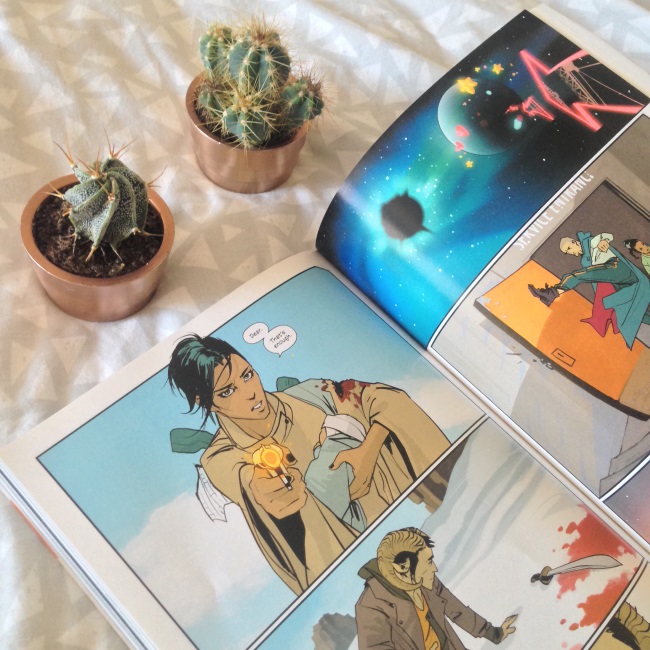
The amount of soil that ended up on my bed due to these photos was not worth the end result...
We see some of the most bizarre life forms anyone could imagine, and watch as they have explicit sex, get into bloody fights, swear, argue and generally dick about during an intergalactic war. The story revolves mostly around the two new parents trying to find a way off the war torn planet with their newborn baby, but we also meet those hunting them. A robot prince with a pregnant wife, a woman who looked like Meryl Streep had ten seconds to dress as a unicorn, a strange but awesome topless dreadlocked spider assassin lady and 'The Will' a bounty hunter with a giant lie detector sphinx cat, who looks to be being set up as the 'not all bad' bad guy. It really does seem like they had a brainstorm where anything goes and then couldn't bear to lose any of the ideas. I won't pretend it's not weird as balls but Saga does seem to be carrying it off so far!
As graphic novels are so damn short there isn't a whole lot more to say. The story is incredibly silly, a tonne of fun and the art is absolutely excellent. I'll be purchasing the next few volumes soon and will do a catch up review once I have more story to talk about.
In the mean time let me know if you've read any of Saga and what you thought!
Thank you for reading,
Isabelle
xox


Hibo Wadere's memoir is utterly devastating, but should be compulsory reading around the globe. I read this in less than 48 hours, unable to really focus on anything else. I had no idea the brutality of the practice, and more shocking was how prevalent it is, even here in the UK.
We follow Hibo from a six year old awoken in the early hours of the morning, led into a tent at the bottom of her garden by her mother, held down by her aunts and mutilated in a painful, undignified and barbaric manner. It does not make easy reading, Wardere spares no details of her ordeal, however the descriptions of the pain and fear she felt are incredibly powerful, and truly bring home how hideous the practice is.
We follow Hibo from a six year old awoken in the early hours of the morning, led into a tent at the bottom of her garden by her mother, held down by her aunts and mutilated in a painful, undignified and barbaric manner. It does not make easy reading, Wardere spares no details of her ordeal, however the descriptions of the pain and fear she felt are incredibly powerful, and truly bring home how hideous the practice is.
Her story describes growing up, living with FGM; the shame, the pain, the constant infections, and the now destroyed relationship with her mother who she saw as the reason for her troubles, until she grew up and decided to start a new life in England, where she could protect her own future daughters from the fate she suffered. She begins her new life, falls in love, settles into the English culture, and has some minor surgery to relieve some of the difficulties of her mutilation. However she comes to realise that her new sanctuary isn't as safe as she had first thought and slowly faces the reality that FGM is a prevalent problem in many communities in the UK, and that there were girls at the school in which she worked who could be in danger.
Hibo could have buried her head in the sand, ignored the issue and continued to live peacefully. Instead she decided this was her chance to take a stand. She used her position as a classroom assistant to bring attention to the teachers, many of whom knew little to nothing about the practice. A few even thought it was a harmless, even joyful, coming of age ritual. Wardere used her own testimony to educate the staff, and she found herself being invited to speak at other schools, explaining the reality of FGM and it's consequences, and teaching them to spot the warning signs of vulnerable girls. Hibo's message has since spread and she is nationally recognised as one of the leaders in the movement against FGM today.
Her story is harrowing all the way through, however it is ultimately one of triumph. She has survived one of the most disgraceful abuses still considered acceptable in parts of the world and used her experience to save other women. She talks with grace and conviction and her testimony is engaging. She highlights the importance of the role men must play in ending FGM, by taking a stand and saying that preserving a woman's supposed purity is no justification for removing sections of a child's genitals and stitching them up, leaving them with a hole the size of a hole-punch puncture through which they must urinate and bleed. All so that their husband can be assured that his wife is untouched on their wedding night... before getting to break her in... leading to several days in hospital.... But y'know we don't need feminism anymore. She also does a beautiful job of talking delicately about the women who allow the practice to continue, and get their daughters cut. Rather than vilifying them, she looks instead at the culture that fears female sexuality, and brainwashes them into prioritizing purity over all else, because it will ensure a good marriage, and therefore a good secure future for their daughters, who have no other opportunity to create a good life for themselves.
I would urge anyone to read this book, it has truly opened my eyes to something that I have allowed myself to ignore for too long. Maybe I don't have any power to stop this happening as an individual, but part of eradicating this is creating the conversation, ensuring that we as a society are informed and united against this practice. Only by creating an open dialogue about a problem that is so taboo can we begin to develop legal policies protecting children, and perhaps engage with supporters of FGM and present a united front against their way of thinking. Steps have already been taken in the right direction but there is a long way to go. It's not simply a matter of implementing laws or catching the cutters, it's a case of changing a cultural mindset that has gone mostly unchallenged for generations. It's a long uphill struggle but Hibo Wardere's passion and power make me feel like perhaps it can be done.
All of this aside, go read the fucking book. Deal with the discomfort and come out a more educated person, with a deeper knowledge of something that is often treated as a shameful secret. You will not regret it.
Here are a few other resources for anybody interested in finding out more.
Hibo could have buried her head in the sand, ignored the issue and continued to live peacefully. Instead she decided this was her chance to take a stand. She used her position as a classroom assistant to bring attention to the teachers, many of whom knew little to nothing about the practice. A few even thought it was a harmless, even joyful, coming of age ritual. Wardere used her own testimony to educate the staff, and she found herself being invited to speak at other schools, explaining the reality of FGM and it's consequences, and teaching them to spot the warning signs of vulnerable girls. Hibo's message has since spread and she is nationally recognised as one of the leaders in the movement against FGM today.
Her story is harrowing all the way through, however it is ultimately one of triumph. She has survived one of the most disgraceful abuses still considered acceptable in parts of the world and used her experience to save other women. She talks with grace and conviction and her testimony is engaging. She highlights the importance of the role men must play in ending FGM, by taking a stand and saying that preserving a woman's supposed purity is no justification for removing sections of a child's genitals and stitching them up, leaving them with a hole the size of a hole-punch puncture through which they must urinate and bleed. All so that their husband can be assured that his wife is untouched on their wedding night... before getting to break her in... leading to several days in hospital.... But y'know we don't need feminism anymore. She also does a beautiful job of talking delicately about the women who allow the practice to continue, and get their daughters cut. Rather than vilifying them, she looks instead at the culture that fears female sexuality, and brainwashes them into prioritizing purity over all else, because it will ensure a good marriage, and therefore a good secure future for their daughters, who have no other opportunity to create a good life for themselves.
I would urge anyone to read this book, it has truly opened my eyes to something that I have allowed myself to ignore for too long. Maybe I don't have any power to stop this happening as an individual, but part of eradicating this is creating the conversation, ensuring that we as a society are informed and united against this practice. Only by creating an open dialogue about a problem that is so taboo can we begin to develop legal policies protecting children, and perhaps engage with supporters of FGM and present a united front against their way of thinking. Steps have already been taken in the right direction but there is a long way to go. It's not simply a matter of implementing laws or catching the cutters, it's a case of changing a cultural mindset that has gone mostly unchallenged for generations. It's a long uphill struggle but Hibo Wardere's passion and power make me feel like perhaps it can be done.
All of this aside, go read the fucking book. Deal with the discomfort and come out a more educated person, with a deeper knowledge of something that is often treated as a shameful secret. You will not regret it.
Here are a few other resources for anybody interested in finding out more.
A Guardian Article about FGM becoming increasingly medicalised for profit
A Map showing the rates of FGM across England.and Wales
A Map showing the rates of FGM across England.and Wales
Thank you for reading
Isabelle
xox

The Vegetarian - Hang Kang - 2015 - Portobello Books
While scrolling through my pictures that I'd taken of this book while reading it I became very aware that I hadn't managed to get a single one where I wasn't about to eat something... The irony is not lost on me but at least I didn't use the McDonald's pic...
This book has been getting a lot of attention recently, and I've been making more of an effort recently to read more diversely, and to read translated works. I'd also just finished All the Light we Cannot See and The Long Way to a Small Angry Planet which are both pretty chunky, slow burning books, so I was looking for something short and snappy to break things up. All of these factors culminated in me reading the Vegetarian, and I'm so glad I did.
This book is short, but it is not an easy read. It is a rather harrowing account of a meek, submissive Korean housewife, beginning to lose her mind. It's hard to explain too much of this book without ruining the very carefully constructed narrative, but essentially her story is told in three acts, through the eyes of first her husband, then her brother-in-law, and finally her sister. We follow her through the eyes of other characters so we never get a true account of what is going on inside this woman's head, how mentally sound her decisions are, to what extent she understands what she is doing. It's impossible to truly identify with her, as such she remains a distant, though not unsympathetic character throughout the novel. In many ways this story isn't really even about her, it's about the people around her, and their reactions to watching this woman completely turning her back on societal expectations and decisions. It's about her husband, worrying more that his wife's eating habits will embarrass him in front of his co-workers, than the reasons she is suddenly eschewing meat. It's about her brother-in-law, an ageing failed artist, who sees his sister's wife's sudden transformation as a spark that could rekindle his artistic fervor. Through all of the acts, it is about her sister, a self made woman who has survived by always doing the right thing, faced with this sudden act of rebellion, wondering whether her own life is simply slavery to societal expectation and nothing more.
This book is appalling, without being melodramatic. Kang does a beautiful job of treading this fine line of controlled hysteria. The novel shows one awful scene after another, but each is relayed in this incredibly restrained way, never getting to the stage where we're rolling our eyes and the suspension of disbelief has worn thin. Deborah Smith's translation is gorgeous as well. Obviously I cannot compare to the original Korean, but the sparse, beautifully written prose perfectly relays the bleak, bizarre narrative and the ways in which imagery and natural scenes are described is rich and melancholic.
I would really recommend reading The Vegetarian, I'm definitely going to reread it in a few months, as I don't feel the first time round was quite enough to truly absorb the intricacies of the novel and I definitely want to spend some more time picking it apart.
Let me know if you've read this book and what you thought!
Thanks for reading,
Isabelle
xox

All the Light We Cannot See - Anthony Doerr - 2015 - Scribner
So I saw this book getting a lot of praise, but all I knew about was that it followed a blind girl, and an orphan, in World War II. Quite frankly that immediately put me off and made me dismiss it in my mind as a cheap yank on the heartstrings with no real substance. However two of my bookish besties, housemate Holly and fellow bookseller Kieran, told me that it was so much more than that, and that it was a book they KNEW I would love.
I was still unsure, but pulpy quick buck war stories don't win the Pulitzer, so finally I was convinced to pick it up and God I'm so happy I did! ATLWCS is a beautiful novel, and a refreshing take on the well trodden path of the WWII narrative. It took me a good fortnight to get through, I won't say its a gripping read that kept me frantically turning the pages, but every time I opened the book I was drawn into the worlds of Marie-Laure and Werner. Their stories were so rich and beautifully written, made up of these fragmented moments of life, scattered through time, glittering like gems.
What I love most about this novel is that it sets itself apart from the more traditional World War II novels by setting out to find the light in the darkness. Both characters are caught up in tragedy, of course they are, but even in the most harrowing of times the beauty in human relationships remain. Rather than attempting to shock with gory battlefield scenes or forcing tragedy down the throat of the reader, Doerr crafts a story of survival, of quiet defiance and sheer will. It's a story about wonder, and the importance of owning your own mind. Werner is driven by scientific curiosity but restricted by the rise of the Nazi regime as they attempt to stomp out any characteristics that do not adhere to their vision of 'perfection', Marie lives adventure after another through her braille books and the games of imagination she plays with her great uncle but is housebound in the midst of the French resistance. We follow both characters through two very different coming-of-age stories and watch as their two stories wind ever closer together.
The writing is beautiful but very occasionally slips into being bloated and a little over flamboyant. and the story has moments where it's so dense you have to wade through it a little bit. The novel also jumps around in time which can become disorientating now and again. For me the biggest flaw in the novel is in the ultimate climactic scenes in which the various threads finally weave together. These passages honestly feel slightly rushed, as if Doerr had actually become slightly bored with building up to the ending and just wanted it out of the way so he could get on with the 'ten years later' style ending chapters. Having flitted in and out of the situation the entire way through the novel I was expecting something a little more sensational than what I got. But perhaps that was the point. The novel consistently refuses the melodramatic and seeks out the subtle moments buried under the drama. These qualms aside it is a glorious read. Gentle and understated but honestly unforgettable. It's definitely a novel I'd recommend. For the most part the gentle story and short chapters make it a relatively easy read but it has so much substance and is an incredibly enjoyable, sumptuous reading experience.
Let me know if you've read this, and what you thought!
Thank you for reading,
Isabelle
xox

The Long Way to a Small Angry Planet - Becky Chambers - 2015 - Hodder and Stoughton
*Reading Copy kindly provided by the Publishers for Review*
"'I cannot pretend the war never happened, but I stopped fighting it long ago. I did not start that war. It should never have been mine to fight.' He sank down so that he could look Rosemary square in the eye. 'We cannot blame ourselves for the wars our parents start. Sometimes the very best thing we can do is walk away.'"
The Long Way to a Small Angry Planet is a masterful blend of sci - fi and literary fiction. It centers around a rag tag cast of characters that make up the crew aboard a ship as they complete their tasks of punching wormholes through space for intergalactic travel between worlds.
The sheer scope of the worlds created by Chambers was incredible. Our main focus is the crew of the Wayfarer but through their journey together, as their personal stories are unfolded we get glimpses into this enormous expanse of worlds full of diverse cultures, religions and moral values. Chambers does a beautiful job of painting each different species as diverse within itself, just as humans are, as opposed to the planets of hive minded beings often found in sci-fi. The depth of imagination that Chambers has is incredibly impressive and it was a delight to find out about each different planet and it's inhabitants.
The individual characters are the standout point for me. The Wayfarer's crew are all incredibly rich, interesting people, and come together to make a unit that is as much a family as it is a crew. They may butt heads and disagree, some of them straight up dislike each other but reading about the ways in which they share each others lives and look after one another is actually quite beautiful. The side characters are also incredibly fun and I want to throw this book at all sci-fi and fantasy writers who recycle the same character tropes for women over and over again because Chambers creates a multitude of complex female characters seen constantly throughout the novel and I fucking love it.
Ultimately, although this is without doubt a sci - fi book, it is so much deeper than your average pulpy action packed space mission. This book is, at it's core, about what it means to be alive. What it means to be a person and how a group, whether it's the crew of one pokey little space ship or the entire Galactic Commons, can come together as a family or break apart into chaos.
I feel like if you loved The Martian by Andy Weir, I feel like this is a natural next step. Sci - Fi written in a witty and unpretentious style but incredibly memorable and full of depth. This was my first five star review for 2016 and it's going to take something very special to meet the standard this has set.
The sheer scope of the worlds created by Chambers was incredible. Our main focus is the crew of the Wayfarer but through their journey together, as their personal stories are unfolded we get glimpses into this enormous expanse of worlds full of diverse cultures, religions and moral values. Chambers does a beautiful job of painting each different species as diverse within itself, just as humans are, as opposed to the planets of hive minded beings often found in sci-fi. The depth of imagination that Chambers has is incredibly impressive and it was a delight to find out about each different planet and it's inhabitants.
The individual characters are the standout point for me. The Wayfarer's crew are all incredibly rich, interesting people, and come together to make a unit that is as much a family as it is a crew. They may butt heads and disagree, some of them straight up dislike each other but reading about the ways in which they share each others lives and look after one another is actually quite beautiful. The side characters are also incredibly fun and I want to throw this book at all sci-fi and fantasy writers who recycle the same character tropes for women over and over again because Chambers creates a multitude of complex female characters seen constantly throughout the novel and I fucking love it.
Ultimately, although this is without doubt a sci - fi book, it is so much deeper than your average pulpy action packed space mission. This book is, at it's core, about what it means to be alive. What it means to be a person and how a group, whether it's the crew of one pokey little space ship or the entire Galactic Commons, can come together as a family or break apart into chaos.
I feel like if you loved The Martian by Andy Weir, I feel like this is a natural next step. Sci - Fi written in a witty and unpretentious style but incredibly memorable and full of depth. This was my first five star review for 2016 and it's going to take something very special to meet the standard this has set.
Thank you for reading!
Isabelle
xox
xox

How do we reconcile the imperfections of feminism with all the good it can do? In truth, feminism is flawed because it is a movement powered by people and people are inherently flawed.
Bad Feminist was the second book I read this year, the first being Harry Potter and the Philosopher's Stone and the two in succession kicked off my reading year beautifully. Bad Feminist is a collection of essays in which Gay talks about a range of social issues, centering around gender and race.
| I think this is what How to Be a Woman by Caitlin Moran was trying to be. It covers feminism in all it's complexity, in a broad and accessible way, drawing on examples from pop culture, such as movies like Django and The Help and of course Robin Thicke's infamous Blurred Lines, to show the ways in which social inequality of both sex and race still exist in a world that many claim treats everybody as equal. The majority of the ideas in essays focusing on inequality between the sexes were familiar to me, though it was very interesting and somewhat horrifying to learn more about the Southern states of America and the political struggles over rights to contraception and terminations. I didn't realise it was so damn terrible. What I really enjoyed was the insight I got into the black experience, which is something I hadn't been expecting to be included to the degree it was. A major flaw in 'liberal white feminism' is the tendency to ignore racial inequality as interwoven with gender inequality. The two come from the same place, the same set of cultural priorities, and it is a huge failing of anyone who advocates for one, to disregard the other. I was also really happy to see her discuss 'feminism' as a term for a very broad ideology, which can be applied to a wide range of different ways of thinking. Often feminism is thought of as this hive of borg queens all working to topple men into the dust. *eye roll*. Instead Gay argues that feminism is simply the desire for equality and freedom between the sexes, and that freedom and equality mean different things for different people. Roxanne Gay is fun and engaging and has a real gift for discussing ideas and building arguments with passion and personal experience, without sacrificing intelligent, critical thought. It's not exactly the magnum opus of the current fight for equality, nor is it going to spark massive debates and create some kind of new wave of feminism, but it's an excellent place to start
Isabelle
xox
|
.JPG)
So I'm back from Uni for the Easter holidays! I had a really stressful last couple of weeks as I slogged to get three 2000 word essays plus a creative writing piece done for the last Friday of term. As a result I found myself horribly stressed, not sleeping or eating properly, developed a horribly cold that I'm still dealing with and generally wrapping myself up into a little knot of anxiety about the whole thing. Then on the last day of term, having had about three hours sleep, I crawled out of bed, trudged the half an hour to my campus, printed out the 65 pages (!!!) worth of essay, handed it all in, trudged back home, threw some stuff in a suitcase and got my laundry in a bag and two hours later got back to my parents house and collapsed into bed.
Phew! The gist of where I'm going with this is that I have been in need of some serious pampering and relaxation lately and last night I got it. When I came home my lovely mama had left a little bag of treats for me in my room and this little beauty was among them. The Sweet Fluffy Cupcake bath and shower gel from Philosophy. She'd found it in TK MAXX for a few pounds and snapped up one for each of us. What a star.
I've never actually tried the 'real' philosophy products before. I'd tried a lot of imitations, almost everywhere does that shape of bottle with a similar style of branding on it and similar smells and I've used quite a few over the years, but my goodness this was something else. I ran a hot bath and swirled a scoop of this into the running water and it lathered up like a dream filling the tub with thick white foam and when I used it on a puff on my body it was creamy and moisturising and felt so luxurious.
Also the smell. The smell. It's amazing. A lot of the 'imitation' ones have a cupcake style version but it's usually a nice but pretty uninspired vanilla-batter scent. This really does smell like thick sugary frosting and is so sweet that straight out of the bottle it can actually smell a little sickly but is a joy to sink into and just lingers on the skin a little afterwards.
I've looked for this product on the Philosophy site and places that stock it, but it was a Christmas release and so I can't imagine it being out in late March. My point is, though, that I think I have been converted to buying real Philosophy products, instead of the £2.99 offerings from Tesco's and the like. There's just no comparison in quality and I'm really interested to see what other amazing scents are available, I have a feeling I'll be stocking up!
Let me know if you've tried any Philosophy products and how they compare with the cheaper versions, I'd be interested to know what you think!
>> On Repeat . Brain - Banks <<
.JPG)
.JPG)
Another LUSH review! (yay!) I'm back at uni now (boo! work!) and as such have had to give up my luxurious bubbly baths in favour of frugal, water saving quickie showers, which is what happens when you and 6 other people share a water bill. I knew this was coming, and that it would be another month at least until I got to visit home and pamper myself properly again. Therefore, the night before I left for uni, after I'd packed and gotten all my stuff sorted, I had the mother of all bubble baths with this baby.
The comforter bubble bar is one of my favourite LUSH products, definitely in my top five (Blog post idea anyone?) It smells like fruity, juicy berries and turns the water a luxurious magenta colour. It's also HUGE, meaning that it can easily be cut in half and used twice, with each half producing plenty of bubbles. While I do that most of the time, I decided to go all out and actually crumbled the whole thing into the tub before sinking into the mountainous peaks of pink foam. Heaven. I also really do feel that my skin benefits from this particular bubble bar, though that could just be because I enjoy using it so much, but I definitely find my skin feeling softer and moisturised which is great.
For me this is the perfect wind down after a string of stressful days, as the scent isn't too sugary or citrus based, it isn't 'energizing' (who on earth takes energizing baths I ask you?) and gets you all relaxed and ready to slip into your 'fresh from the tumble dryer' jammies and settle down to a good film or book for the evening. My overall impression of this product therefore: Buy it! Buy it now!
The comforter bubble bar is one of my favourite LUSH products, definitely in my top five (Blog post idea anyone?) It smells like fruity, juicy berries and turns the water a luxurious magenta colour. It's also HUGE, meaning that it can easily be cut in half and used twice, with each half producing plenty of bubbles. While I do that most of the time, I decided to go all out and actually crumbled the whole thing into the tub before sinking into the mountainous peaks of pink foam. Heaven. I also really do feel that my skin benefits from this particular bubble bar, though that could just be because I enjoy using it so much, but I definitely find my skin feeling softer and moisturised which is great.
For me this is the perfect wind down after a string of stressful days, as the scent isn't too sugary or citrus based, it isn't 'energizing' (who on earth takes energizing baths I ask you?) and gets you all relaxed and ready to slip into your 'fresh from the tumble dryer' jammies and settle down to a good film or book for the evening. My overall impression of this product therefore: Buy it! Buy it now!
Thankyou for reading!
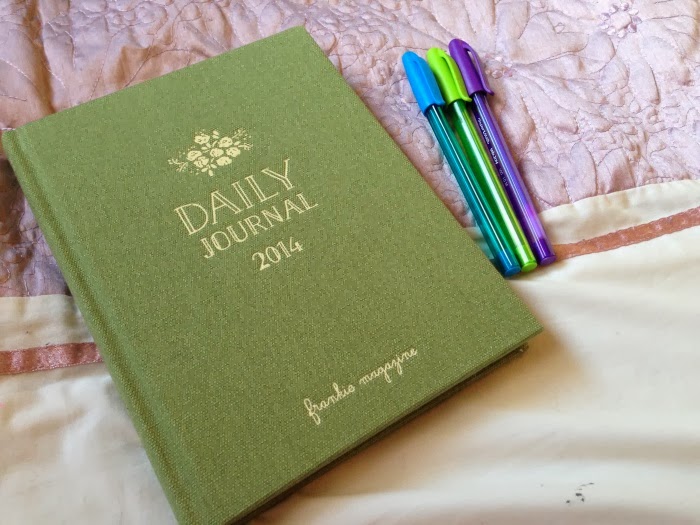
Hello all! It's been a little while since I've shown myself round these parts but part of my routine, compulsory News Year's resolutions is to be a little more regular with blogging. I've really missed being part of this community and I hate leaving my little blog neglected. So to make some time for blogging I'll need to start keeping myself organised, and what better way to do it than in style with the coveted Frankie Diary 2014 edition! I wanted one of these last year but they had sold out by the time I got round to it. I wasn't having any of that this year, I bought it myself at the beginning of December and had Mama pay me back for it and put it in my Christmas box for when I came home from Uni.
It is absolutely gorgeous, all floral prints and soft watercolour palettes and it's really well put together. It begins with a 'calendar' style layout page for each month and then a few pages giving a little space dedicated to every day, with each month getting an individual design. Then there are pages for birthdays, budgeting, extra notes and a few pages of stickers and lists and other fun bits and pieces so I'm really really happy with it. It retails at about £20 including shipping from it's native Australia.
I've already started to fill mine in, too impatient to wait for the New Year to kick in! I'm hoping to use it as a planner and organiser, as opposed to filling it in retrospectively, diary style. I could use my phone, but there's something so satisfying about having plans and deadlines written down by hand, I'm far more likely to remember them too! So if part of your New Years resolutions include being more organised definitely consider nabbing one of these for yourself.
.JPG)
.JPG)
You can buy them here at the Frankie Press website. They were still in stock but selling fast when I last checked so get yourself one if you don't want to miss out!
I'm hopefully going to be much more organised with my time in 2014 which will mean better blogging! Though of course a return for me means a return for Cat photo-bombing my pictures while she whines meows for food/cuddles/food. The joys of pet ownership eh?
Thankyou for reading and I will hopefully talk to you again soon.
Thankyou for reading and I will hopefully talk to you again soon.

Subscribe to:
Posts (Atom)


.JPG)